
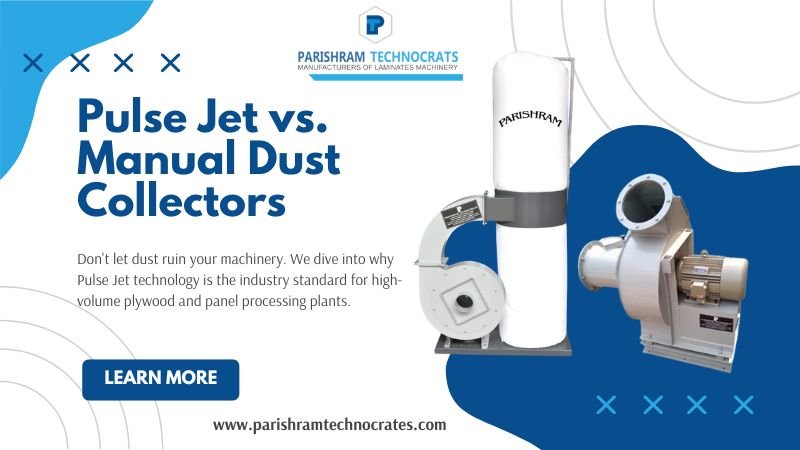
In any high-volume panel processing or plywood facility, dust isn’t just a nuisance—it’s a threat to your equipment’s precision and your workers’ health. While every factory has some form of dust extraction, the type of system you choose determines whether you are truly protecting your investment or just moving dust around.
At Parishram Technocrats, we often see clients struggling with “suction loss” in their factories. Usually, the culprit isn’t the motor—it’s the cleaning technology.
1. The Manual Shaker: The Old Standard
Manual shaker systems rely on a mechanical arm or a hand-operated lever to shake the filter bags.
The Downside: You must stop the entire production line to clean the filters.
The Risk: If workers forget to shake the bags, back-pressure builds up, causing your Laminate Sanding Machine to overheat or leaving fine dust to settle on your finished boards, causing scratches.
2. The Pulse Jet Advantage: Non-Stop Production
A Pulse Jet Dust Collector uses a completely different logic. It uses high-pressure bursts of compressed air to “pulse” the bags from the inside out while the machine is still running.
Continuous Operation: There is no need to shut down for cleaning. Your production stays at 100% capacity.
Superior Air-to-Cloth Ratio: Because the bags are cleaned every few seconds, the suction remains consistent, ensuring that 99.9% of particles are captured immediately at the source.
3. Impact on Machine Longevity
Dust is abrasive. When it gets into the bearings of your Heavy Duty Cutting Machine or the pneumatic cylinders of your Scissor Lift, it acts like sandpaper, wearing down components prematurely.
By installing an engineered filtration system, you aren’t just cleaning the air; you are extending the life of every other machine on your floor.
4. Environmental & GIDC Compliance
Industrial zones across India are becoming stricter regarding air quality. A Pulse Jet system ensures that the air exhausted back into the atmosphere (or your factory) is free of respirable dust. This keeps your facility compliant with safety norms and avoids the risk of heavy fines or forced shutdowns.
5. Choosing the Right Capacity
It’s not just about the HP (Horsepower). To get the right system, you need to calculate the CFM (Cubic Feet per Minute) required for your specific toolset. A 7.5 HP system might work for a small workshop, but a 15 HP or 20 HP Pulse Jet system is the “gold standard” for industrial-scale operations.
Conclusion: A Clean Factory is a Profitable One
Investing in a high-quality dust extraction system is an investment in your brand’s reputation. Cleaner air leads to better finishes, healthier employees, and fewer machine breakdowns.
Is your current dust collector keeping up with your production?
Explore the technical specifications of our Pulse Jet Dust Collection Systems or contact our engineering team to calculate the CFM requirements for your factory layout.