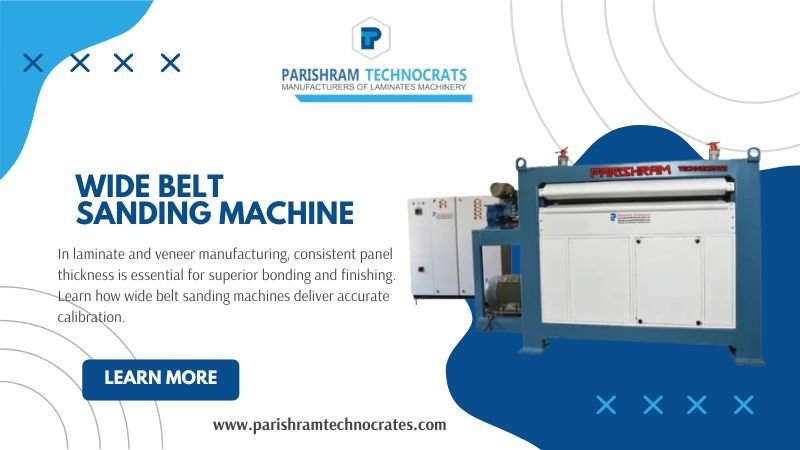
In plywood, MDF, particle board, and laminate manufacturing, achieving a smooth surface is only part of the finishing process. Consistent panel thickness is equally important for producing high-quality finished products.
Even small thickness variations can create problems during laminating, edge banding, cutting, and final assembly. A wide belt sanding machine ensures every panel maintains a uniform thickness, improving product quality and reducing material rejection.
Why Thickness Calibration Matters
Accurate thickness tolerance calibration helps manufacturers maintain consistency throughout production.
Uneven panels can lead to:
- Poor laminate bonding
- Uneven surface finish
- Difficulty during edge banding
- Higher material rejection
- Increased machine wear
A properly calibrated sanding machine removes high spots while maintaining uniform thickness across the entire board.
Precision Sanding with Wide Belt Technology
Modern wide belt sanding machines use multiple sanding heads to achieve both calibration and finishing in a single pass.
Calibrating Roller
Pneumatic Sanding Platen
After calibration, the panel passes beneath a pneumatic sanding platen fitted with heavy-duty abrasive belts.
This stage smooths the surface without affecting the calibrated thickness, producing an excellent finish ready for laminating or coating.
Digital Thickness Setting for Better Accuracy
Modern sanding machines feature digital thickness setting systems that allow operators to adjust sanding dimensions quickly and accurately.
Benefits include:
- Consistent panel thickness
- Faster machine setup
- Reduced operator errors
- Improved production efficiency
- Better repeatability for batch production
Digital controls also minimize manual adjustments, making production more reliable.
Preventing Panel Delamination
Poor thickness consistency directly affects adhesive performance.
When panel surfaces are uneven, pressure distribution during lamination becomes inconsistent. This may lead to:
- Weak adhesive bonding
- Air pockets
- Edge lifting
- Panel delamination
- Reduced product life
Uniform sanding creates a flat surface that allows adhesives to bond evenly across the entire panel.
Integrating the Sanding Line
A modern sanding line works best when connected with other production equipment.
A typical workflow includes:
- Hydraulic Scissor Lift for easy material loading
- Industrial Conveyor Systems for continuous feeding
- Wide Belt Sanding Machine for calibration and finishing
- Heavy Duty Cutting Machine for accurate sizing
- Automatic PP Wrapping Machine for surface protection
This integrated process reduces manual handling while improving production speed and consistency.
Dust Extraction Improves Sanding Quality
Wood dust can affect sanding accuracy and reduce abrasive belt life.
Connecting the sanding machine to a Pulse Jet Dust Collector helps:
- Keep the sanding surface clean
- Improve abrasive performance
- Extend belt life
- Reduce maintenance
- Maintain consistent surface quality
A cleaner working environment also improves operator safety and machine reliability.
Conclusion
Consistent panel thickness is essential for producing high-quality plywood, laminate, and engineered wood products. A reliable wide belt sanding machine ensures precise calibration, smooth finishes, and improved bonding performance while reducing production waste.
At Parishram Technocrats, we manufacture robust sanding solutions designed for continuous industrial operation, helping manufacturers improve product quality and production efficiency.