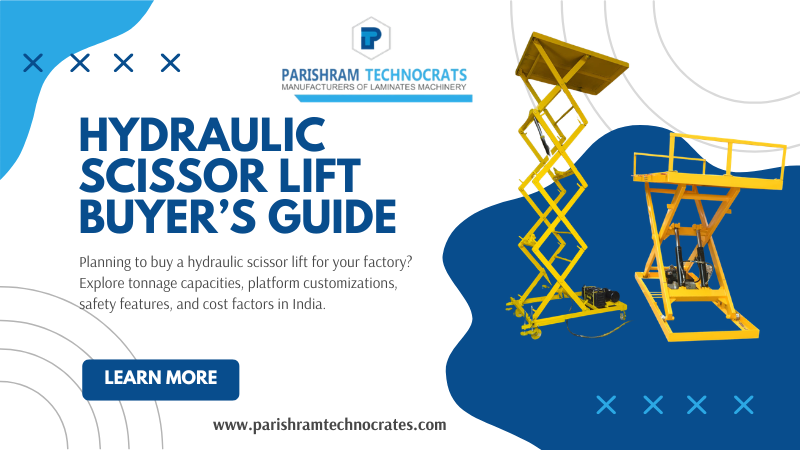
Hydraulic Scissor Lift Buyer’s Guide: Tonnage, Sizes & Factory Pricing Factors
For plant managers, warehouse directors, and procurement officers, selecting the right material handling equipment is a major capital investment decision. A hydraulic scissor lift is one of the most versatile additions to any production floor—eliminating vertical material bottlenecks, speeding up loading dock operations, and improving worker ergonomics.
However, with varying platform sizes, lifting heights, and load capacities available in the market, choosing the wrong configuration can lead to operational delays or unnecessary expenses.
This guide breaks down the critical technical specifications, tonnage requirements, and cost factors you need to know before buying an industrial scissor lift for your facility.
Need an Immediate Quote or Custom Blueprint?
Speak directly with our application engineers in Ahmedabad to get exact technical specifications, drawings, and factory pricing for your plant layout.
1. Understanding Your Tonnage & Load Capacity Requirements
Selecting the correct tonnage capacity depends on your maximum daily dynamic load—including the weight of pallets, materials, forklifts, or personnel using the platform.
Our industrial scissor lift portfolio is engineered across four primary operational tiers:
| Lift Series / Tier | Load Capacity | Ideal Factory Applications |
| Compact Workstation Lifts | 500 kg – 1 Ton | Ergonomic assembly lines, small component staging, packing bays |
| Standard Industrial Lifts | 2 Ton – 3 Ton | Plywood & laminate sheet feeding, machine intake staging, warehouse docks |
| Heavy-Duty Cargo Lifts | 5 Ton – 8 Ton | Die loading, heavy metal processing, inter-floor material transfer |
| Ultra-Heavy Tonnage Lifts | 10 Ton – 20+ Ton | Automotive plants, heavy industrial equipment assembly, container unloading |
Rule of Thumb: Always select a lift capacity rated at least 20% to 25% higher than your heaviest expected load to account for sudden shock-loading when material is dropped onto the platform by a forklift.
2. Platform Dimensions & Vertical Travel Height
Platform size and lifting height directly dictate the structural framework and cylinder setup required for your machine.
- Single Scissor Mechanism: Best for lower lifting heights (up to 2.5 meters) where high platform stability and high tonnage capacity are required.
- Multi-Scissor (Double/Triple) Mechanism: Required when vertical travel height exceeds 3 meters (e.g., mezzanine floor transfer or multi-story material movement) while maintaining a compact pit or floor footprint.
3. Key Cost Drivers: What Determines Hydraulic Scissor Lift Pricing?
When requesting a quotation from a heavy-duty scissor lift manufacturer, several engineering factors influence the final investment cost:
- Hydraulic Power Pack Quality: Branded gear pumps, Italian/Taiwanese solenoid valves, and continuous-duty motors increase initial cost but guarantee zero pressure drops and zero height drift over years of operation.
- Structural Steel Thickness: Lifts built with solid steel arm links resist twisting (deflection) under edge-loading far better than lower-cost hollow-tube alternatives.
- Safety Features Installed: Integrated hose-burst velocity fuses, mechanical maintenance safety bars, overload relief valves, and perimeter safety trip bars add immense operational protection for your workforce.
- Pit-Mounted vs. Floor-Mounted Setup: Pit-mounted installations allow the lift deck to sit flush with your factory floor when fully collapsed, requiring specific structural eye-bolts and pit-frame engineering.
4. Why Industrial Plants Partner with Parishram Technocrats
At Parishram Technocrats, we don’t supply generic off-the-shelf lift tables. Every unit in our hydraulic lift portfolio is engineered from heavy-grade structural steel and tailored to match your exact floor height and workflow cycle.
- Heavy Structural Mass: Built to absorb dynamic impact loads without frame distortion.
- Zero-Drift Hydraulics: Pilot-operated check valves ensure your load holds its exact height during long shift staging.
- Full Workflow Integration: Easily synced with our Industrial Conveyor Systems, Wide Belt Sanding Machines, and automated processing lines.