
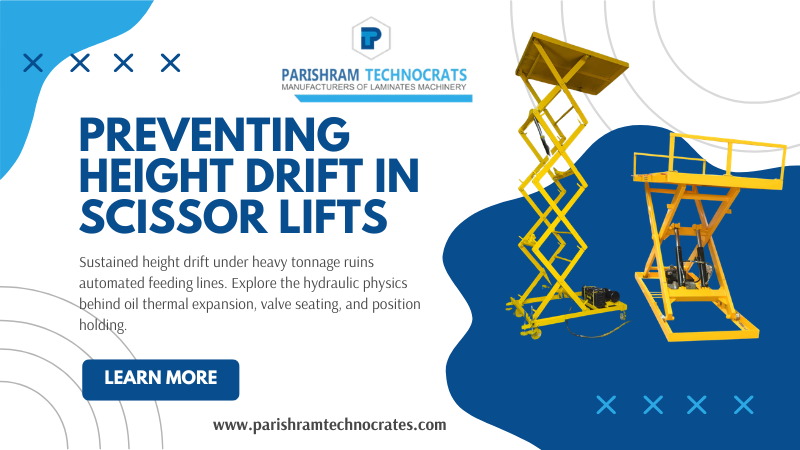
Preventing Height Drift in Scissor Lifts: Hydraulic Viscosity and Valve Tuning
In automated panel processing and heavy assembly environments, a hydraulic lift table is often required to hold a multi-ton load at an exact height for hours. Whether serving as a feeding staging area or an indexing platform, precision is critical. If the platform gradually creeps downward—a phenomenon known as hydraulic height drift—the entire feeding geometry shifts.
As a high-capacity hydraulic scissor lift manufacturer, we know that height drift isn’t just an annoyance; it causes costly machine jams, tool collisions, and production halts. Understanding how fluid thermal viscosity, internal cylinder bypass, and valve seating mechanics affect position-holding is essential to maintaining absolute platform stability.
1. The Physics of Height Drift: Internal Leaks vs. Thermal Expansion
When a scissor platform holding 3 tons begins to sink without an operator pressing the lower button, fluid is escaping from the high-pressure side of the hydraulic circuit back into the reservoir.
- Pilot-Operated Check Valve Seating: The primary defense against fluid backflow is the check valve. Lower-grade valves with soft seals or improper poppet seating suffer micro-leakage under continuous pressure, allowing fluid to slip past and causing the platform to drop millimeter by millimeter.
- Oil Viscosity Degradation: As hydraulic oil cycles continuously through a heavy power pack, friction generates heat. If the fluid’s Viscosity Index (VI) is too low, the oil thins out as it warms up. Hotter, thinner oil slips far more easily past internal cylinder seals and valve spools, accelerating drift rates during long production shifts.
2. Cylinder Seal Bypass and Pressure Equalization
Height drift can also occur internally within the hydraulic cylinder itself, even if the external valves are 100% leak-free.
- Piston Seal Bypass: High-pressure fluid on the blind end of the cylinder can slowly bypass worn or low-tolerance piston seals into the rod end.
- Hardened Polyurethane Seals: To maintain an unyielding position under sustained static tonnage, heavy-duty scissor mechanisms utilize multi-lip, glass-filled PTFE or heavy-duty polyurethane seals that maintain their shape and sealing force even under high thermal stress.
[ High-Pressure Fluid ] ──► [ Hardened PTFE Seal ] ──X (Zero Fluid Bypass into Rod End)
3. Maintaining Synchronized Heights Across Your Plant Workflow
Eliminating vertical drift keeps your material handling line running at maximum speed without operator intervention:
- Automated Feeding: A drift-free lift platform holds heavy sheet stacks at the exact intake height of an automated Industrial Conveyor Systems loop, keeping materials moving continuously.
- Flawless Calibration Entry: Unvaried feeding height ensures panels glide straight into a [Wide Belt Sanding Machine] without catching on the intake table, preserving your strict thickness tolerances.
- Precision Edge Sizing: Materials move directly from the sanding stage into a [Heavy Duty Cutting Machine], where constant height alignment guarantees clean, square edges on every sheet.
4. Protecting Hydraulic Power Packs from Micro-Contaminants
5. Final Packaging and Shipping
Conclusion: Hydraulic Precision Built from the Ground Up
Holding heavy loads at an exact position requires precision fluid dynamics. By engineering power packs with high-viscosity-index fluids, zero-leakage pilot-operated check valves, and hardened cylinder seals, you ensure your vertical lifting platforms deliver solid, unwavering performance on every shift.
At Parishram Technocrats, we build heavy-duty hydraulic lifting systems with over-engineered fluid circuits and massive safety factors, providing rock-solid stability for demanding industrial plants.