
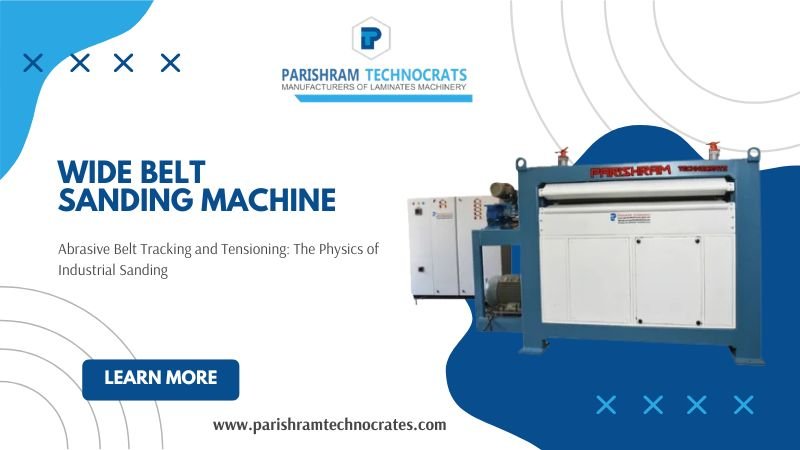
A wide belt sanding machine is designed to deliver smooth, consistent finishes on plywood, MDF, particle board, and other engineered wood products. However, achieving that level of precision depends on more than just the abrasive belt.
Proper belt tracking, accurate tensioning, and effective dust removal all play a major role in maintaining sanding quality and reducing downtime.
As a trusted wide belt sander manufacturer, Parishram Technocrats designs sanding systems that provide stable operation, longer belt life, and reliable performance for continuous industrial production.
Why Belt Tracking Is Important
An abrasive belt moves at high speed during sanding. If it shifts too far to one side, it can wear unevenly, damage the panel surface, or even tear.
Modern sanding machines use automatic tracking systems to keep the belt running in the correct position throughout the operation.
Benefits include:
- Uniform sanding quality
- Reduced belt wear
- Better surface finish
- Lower maintenance
- Longer abrasive life
Pneumatic Belt Tracking System
Most industrial sanding machines use a pneumatic tracking sensor to monitor belt movement.
When the belt begins moving off-center, the sensor automatically adjusts the tracking roller to bring it back into alignment.
This continuous correction helps:
- Maintain stable belt movement
- Prevent edge damage
- Improve sanding accuracy
- Reduce production interruptions
Automatic tracking also minimizes operator intervention during long production shifts.
Importance of Proper Belt Tension
Low Belt Tension
If the belt becomes loose, it may:
- Slip during operation
- Reduce sanding efficiency
- Produce inconsistent finishes
- Increase belt wear
Excessive Belt Tension
Over-tightening creates unnecessary stress on:
- Bearings
- Rollers
- Belt joints
- Machine components
Proper tensioning cylinder dynamics maintain balanced belt pressure for stable and reliable sanding performance.
Controlled Belt Oscillation
Industrial sanding belts are designed to move slightly from side to side during operation.
This controlled abrasive belt oscillation helps:
- Distribute wear evenly
- Prevent continuous sanding in one position
- Improve abrasive life
- Produce a more consistent surface finish
Uniform belt movement also reduces the possibility of visible sanding lines on finished panels.
Roller Design Matters
The quality of the sanding roller directly affects panel calibration.
Machines equipped with the correct roller durometer profile provide:
- Consistent pressure
- Better material removal
- Accurate thickness calibration
- Improved surface smoothness
Selecting the appropriate roller hardness depends on the material being processed and the desired finish.
Preventing Belt Loadingnization
During continuous sanding, wood dust and resin can accumulate on the abrasive surface.
This condition, known as belt loading, reduces cutting performance and increases heat generation.
To minimize belt loading:
- Use quality abrasive belts
- Maintain proper belt tension
- Ensure effective dust extraction
- Replace worn belts on time
Keeping the abrasive clean improves sanding quality and extends belt life.
Dust Collection Improves Sanding Performance
A Pulse Jet Dust Collector is an essential part of any sanding line.
It continuously removes dust generated during sanding, helping to:
- Reduce heat buildup
- Improve abrasive efficiency
- Protect machine components
- Maintain a cleaner working environment
- Extend abrasive belt life
Effective dust extraction also improves overall production quality.
Integrating the Sanding Line
For maximum productivity, the sanding machine should operate as part of an integrated production system.
A typical workflow includes:
- Hydraulic Scissor Lift for material loading
- Industrial Conveyor Systems for continuous feeding
- Wide Belt Sanding Machine for calibration and finishing
- Heavy Duty Cutting Machine for accurate panel sizing
- Automatic PP Wrapping Machine for final surface protection
This workflow reduces manual handling while improving production efficiency.
Conclusion
Consistent sanding quality depends on accurate belt tracking, proper tension control, effective dust extraction, and stable machine design. These factors work together to improve surface finish, reduce downtime, and increase abrasive belt life.
As an experienced wide belt sander manufacturer, Parishram Technocrats develops industrial sanding solutions engineered for continuous production, precision finishing, and long-term reliability.