
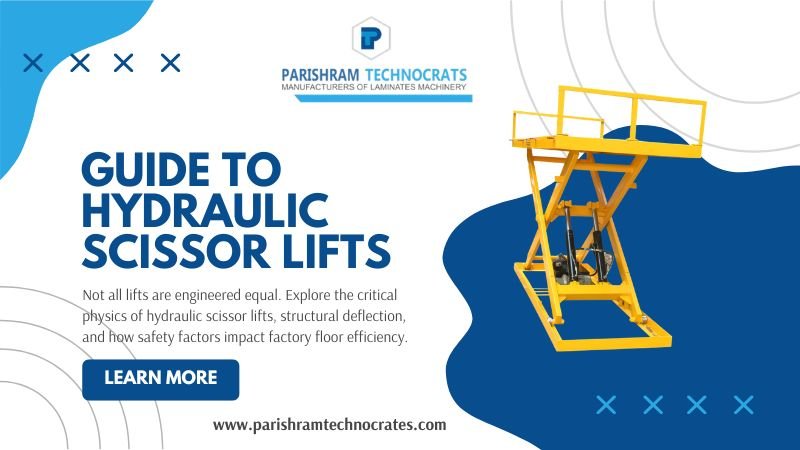
In modern material handling, a lifting platform is much more than a basic mechanical jack. For industrial plants handling heavy tonnage, a hydraulic scissor lift manufacturer must design for complex structural forces, cyclical stress, and volatile load centers.
Whether integrated into a high-speed assembly line or utilized as a standalone platform for heavy dies, understanding the engineering principles behind scissor mechanisms is vital to ensuring long-term operational safety and minimizing mechanical wear.
1. Scissor Arm Geometry and Stress Distribution
The mechanical heart of a lift table lies in its scissor arms. When a lift is fully collapsed, the horizontal angle puts maximum stress on the structural steel and the hydraulic cylinders.
-
The Physics of the Start: The initial lift phase requires the highest hydraulic force because the mechanical advantage is at its lowest.
-
Preventing Deflection: Premium lifting systems utilize heavy-duty solid steel legs rather than hollow tubes. This minimizes structural deflection (twisting or bending) when heavy equipment is shifted across the platform edge.
2. Hydraulic Cylinder Placement and Pressure Regulation
The placement of the cylinders dictates the smoothness of the vertical travel. High-capacity lifts engineered by an expert heavy-duty lifting equipment specialist feature optimized cylinder geometry to maintain uniform velocity throughout the stroke.
-
Dual-Acting Cylinders: For precision applications, utilizing a dual-acting cylinder setup ensures controlled ascent and descent, eliminating the jerky movements common in lower-grade single-acting gravity-descent systems.
-
Velocity Fuses: A critical safety component. In the rare event of a hydraulic hose rupture, an integrated velocity fuse immediately locks the hydraulic fluid in the cylinder, preventing a catastrophic free-fall of the platform.
3. Ergonomic Workstation Design: Impact on Plant Output
Beyond pure transport, scissor tables are essential tools for ergonomic workstation design. Manually bending over to feed material into a high-speed Laminate Sanding Machine or an automatic Heavy Duty Cutting Machine causes repetitive strain injuries and slows down processing cycles.
By maintaining a constant, automated working height, material can be transferred smoothly via Industrial Conveyor Systems directly onto the lift platform, matching the precise intake height of your primary production machinery.
4. Calculating Load Dynamics: Static vs. Dynamic Capacity
A frequent mistake on the shop floor is assuming that a lift rated for 2 tons can handle any 2-ton load. Engineers look at two distinct metrics:
-
Uniformly Distributed Load (UDL): The weight is perfectly balanced across the entire top deck.
-
Side/Edge Loading: Occurs when a heavy forklift rolls over the edge of the platform. Edge loading places extreme twisting torque on the scissor rollers and tracks, requiring a rigid structural framework to prevent long-term misalignment.
Conclusion: Investing in Structural Reliability
When upgrading your facility’s material handling capabilities, prioritizing robust engineering over low-cost options protects your workforce and your bottom line. A lift table built with high safety margins ensures uninterrupted duty cycles for decades.
At Parishram Technocrats, we approach material handling through the lens of precision engineering. Every structural component, from the pivot pins to the hydraulic power pack, is tailored to meet rigorous industrial environments.
Ready to eliminate vertical bottlenecks safely?
Analyze the technical blueprints of our Hydraulic Scissor Lift Range or connect with our application engineers in Ahmedabad to customize a solution for your heavy lifting requirements.