
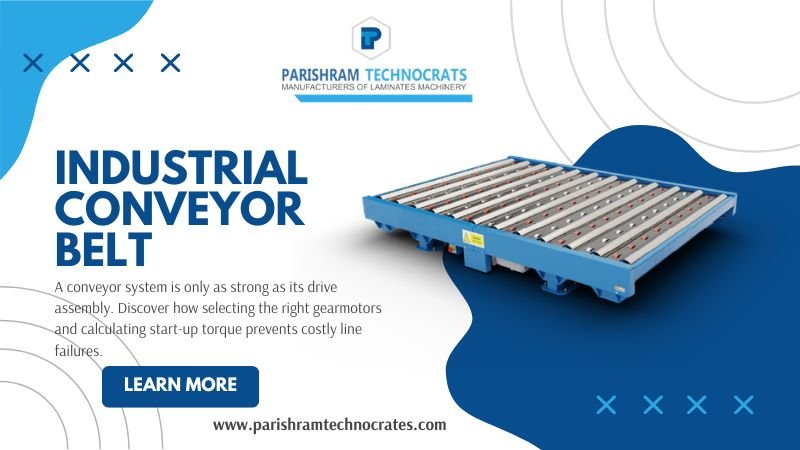
A conveyor may appear simple from the outside, but its drive assembly performs the critical job of moving heavy loads consistently. Motor selection, gearbox ratio, shaft strength, and torque distribution all influence how reliably the conveyor operates.
For an industrial conveyor belt manufacturer, designing the drive system correctly is essential for preventing excessive wear, belt slipping, and unexpected stoppages.
1. Why Start-Up Torque Matters
A conveyor carrying heavy panels, pallets, or components requires significantly more force when starting from a standstill than during normal operation. This is why engineers consider full-load start-up torque rather than selecting a motor only according to running speed. An appropriately sized drive helps prevent:- Motor overload
- Belt slipping
- Sudden acceleration
- Excessive gearbox stress
- Premature component wear
2. Choosing the Right Gearmotor
The gearbox converts motor speed into the torque required at the conveyor drive shaft. For demanding applications, helical gearmotor selection is based on factors such as:- Conveyor load
- Required belt speed
- Operating hours
- Starting frequency
- Gear ratio
- Required output torque
3. Drive Shaft Alignment and Torque Distribution
The drive shaft transfers gearbox output to the conveyor mechanism. Incorrect alignment can create additional mechanical stress and uneven load distribution. Drive shaft torsional stress may result in:- Shaft deflection
- Bearing wear
- Sprocket misalignment
- Chain wear
- Increased vibration
4. Sprocket and Coupling Alignment
Even a correctly selected gearbox can experience problems when the transmission components are poorly aligned. Incorrect sprocket pitch alignment can cause uneven tooth engagement, chain wear, and tracking problems. Depending on the conveyor design, engineers may use:- Hardened drive shafts
- Heavy-duty keyways
- Precision couplings
- Properly aligned sprockets
- Suitable bearing supports