Heavy industrial machines are designed to handle demanding production cycles, but even the most advanced equipment can lose accuracy if vibration is not properly controlled.
From cutting and sanding to conveying and lifting, continuous machine operation generates dynamic forces that affect stability over time. Excessive vibration can reduce machining accuracy, increase maintenance costs, and shorten equipment life.
A reliable industrial machinery manufacturer focuses not only on production capacity but also on structural strength, machine balance, and vibration control to ensure long-term performance.
Why Vibration Control Matters
Industrial machinery experiences continuous movement from rotating motors, moving belts, cutting heads, and heavy material handling.
Without proper mechanical vibration isolation, these forces can spread through the machine structure and even into the factory floor.
Common problems include:
- Bearing wear
- Component misalignment
- Loose fasteners
- Increased maintenance
- Reduced machining accuracy
- Shorter equipment life
Controlling vibration improves both machine reliability and product quality.
Common Causes of Machine Vibration
Rotational Imbalance
Unbalanced motors, rollers, or rotating shafts create continuous vibration that increases wear on moving components.
Dynamic Load Stress
Harmonic Frequency
Strong Machine Structures Reduce Vibration
One of the most effective methods of structural resonance dampening is using a rigid machine frame.
Heavy-duty industrial machines are built with reinforced steel or fabricated structural frames that provide:
- Higher rigidity
- Better load distribution
- Reduced vibration transfer
- Improved dimensional stability
- Longer service life
A strong chassis absorbs vibration more effectively than lightweight structures, helping maintain machine accuracy during continuous operation.
Importance of Proper Foundation and Anchoring
Even the strongest machine requires correct installation.
Proper foundational anchoring keeps equipment stable and prevents gradual movement during long production cycles.
Benefits include:
- Better machine alignment
- Reduced structural movement
- Lower maintenance
- Improved operational safety
- Consistent machining accuracy
Well-designed foundations also protect surrounding equipment from transmitted vibration.
Improving Processing Line Alignment
Machine stability is closely connected to material handling.
Sudden impacts during loading or unloading create unnecessary vibration throughout the production line.
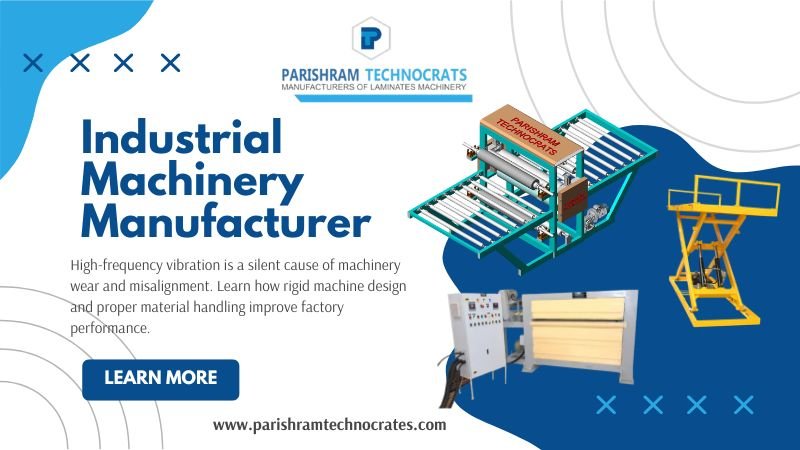
Using Industrial Conveyor Systems allows materials to move smoothly between workstations without sudden shocks.
Similarly, Hydraulic Scissor Lifts position heavy materials at the correct working height, reducing impact during machine loading and improving overall processing line alignment.
A smooth production flow helps downstream equipment operate more accurately.
Supporting Precision Machines
Stable material movement benefits finishing and cutting operations.
For example:
- A Wide Belt Sanding Machine maintains consistent surface calibration when panels move evenly.
- A Heavy Duty Cutting Machine produces cleaner cuts when vibration and blade movement are minimized.
Reducing machine vibration improves dimensional accuracy while lowering wear on mechanical components.
Keep Dust Away from Moving Components
Dust and vibration together can accelerate equipment wear.
Fine particles entering guide rails, bearings, and moving assemblies increase friction and reduce machine life.
Installing a Pulse Jet Dust Collector helps by:
- Removing airborne dust
- Protecting guide systems
- Reducing maintenance
- Improving machine reliability
- Extending component life
A cleaner production environment supports smoother machine operation.
Protect Products After Processing
Stable production should continue through the packaging stage.
Integrating an Automatic PP Wrapping Machine at the end of the production line protects finished products from scratches, dust, and handling damage during storage and transportation.
Continuous automated handling also reduces unnecessary product movement after manufacturing.
Conclusion
Machine stability is one of the most important factors in maintaining long-term production efficiency. Proper structural design, vibration control, accurate installation, and smooth material handling all contribute to improved equipment performance and reduced maintenance costs.
As an experienced industrial machinery manufacturer, Parishram Technocrats designs robust industrial solutions built for continuous operation, structural stability, and reliable performance across demanding manufacturing environments.