In every manufacturing facility, production speed depends on more than the performance of individual machines. The efficiency of moving materials between workstations often determines whether a production line operates at full capacity or suffers from costly delays.
Whether manufacturing plywood, laminates, furniture, packaging materials, engineered wood products, or industrial components, industrial conveyor systems serve as the backbone of modern factory operations. They create a continuous flow of materials, minimize manual handling, reduce product damage, and synchronize multiple production processes into one streamlined workflow.
Many factories invest heavily in high-performance machinery but overlook their material handling infrastructure. Unfortunately, even the fastest cutting machine or sanding line cannot achieve maximum productivity if materials arrive late or accumulate between processes.
At Parishram Technocrats, we engineer complete conveyor solutions that eliminate bottlenecks, improve production line synchronization, and maximize factory efficiency through intelligent layout design.
1. Choosing the Right Conveyor System
No single conveyor design suits every manufacturing application.
Selecting the correct transport medium depends on several factors, including:
- Product weight
- Surface condition
- Material dimensions
- Production speed
- Environmental conditions
- Required transport distance
Understanding these variables helps manufacturers choose between belt conveyors, roller conveyors, or specialized material handling systems.
Heavy-Duty Roller Conveyors
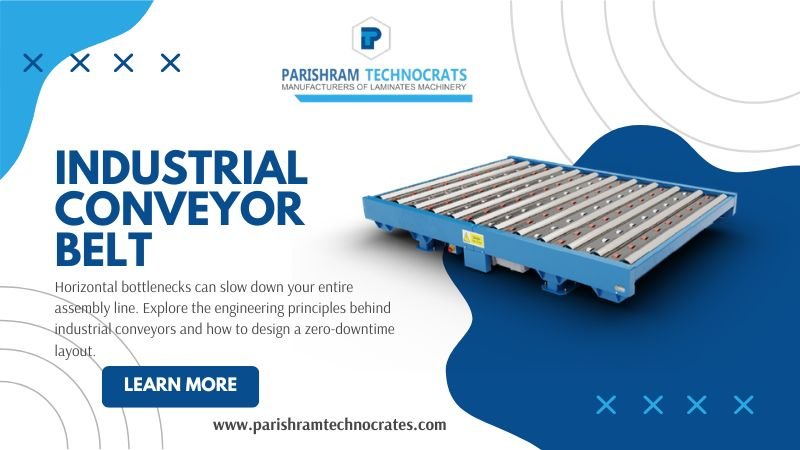
Heavy-duty roller conveyors are designed for transporting rigid products with flat and stable surfaces.
They are commonly used for:
- Plywood sheets
- MDF panels
- Laminates
- Wooden pallets
- Heavy industrial crates
- Steel components
These systems utilize precision-machined rollers mounted on sealed bearings within a rigid structural channel framework, allowing smooth transportation of heavy loads with minimal rolling resistance.
Key Benefits
- High load capacity
- Low maintenance
- Excellent durability
- Reduced friction
- Long service life
Because only the rollers rotate instead of an entire belt, roller conveyors consume less energy when handling large, heavy products.
Industrial Belt Conveyors
When transporting products with irregular shapes or unstable bases, industrial belt conveyor systems provide superior performance.
Applications include:
- Loose components
- Packaging materials
- Small manufactured parts
- Decorative laminates
- Raw boards
- Cartons
Unlike roller conveyors, belt conveyors provide continuous support beneath the product, preventing movement during transportation.
Selecting the Correct Belt Material
One of the most important engineering decisions involves choosing the proper conveyor belt.
The selected belt must provide the correct combination of:
- Belt tensile strength
- Abrasion resistance
- Heat resistance
- Oil resistance
- Chemical compatibility
- Surface grip
Choosing the wrong belt increases maintenance frequency, causes belt stretching, and reduces conveyor lifespan.
High-quality industrial belts maintain dimensional stability even during continuous operation under heavy production loads.
2. Conveyor Drives and Speed Synchronization
Variable Speed Drives (VSD)
Instead of operating at one fixed speed, premium conveyor systems use Variable Speed Drives (VSDs) to automatically regulate belt movement according to production requirements.
Advantages include:
- Smooth acceleration
- Controlled deceleration
- Lower energy consumption
- Reduced product impact
- Better machine synchronization
This flexibility allows conveyors to match the processing speed of:
- Laminate sanding machines
- Heavy-duty cutting machines
- Automatic wrapping machines
- Packaging stations
Proper speed control prevents product accumulation while maintaining uninterrupted production.
Conveyor Belt Tensioning
Over thousands of operating hours, conveyor belts naturally stretch.
Without proper tension control, operators may experience:
- Belt slippage
- Misalignment
- Uneven tracking
- Reduced transport accuracy
- Increased wear
Industrial conveyors solve this using engineered take-up systems.
Common options include:
Screw-Type Tensioning
Gravity Take-Up Systems
3. Integrating Horizontal and Vertical Material Handling
Incoming Raw Material
          │
          ▼
Industrial Conveyor System
          │
          ▼
Hydraulic Scissor Lift
          │
          ▼
Laminate Sanding Machine
          │
          ▼
Heavy Duty Cutting Machine
          │
          ▼
Automatic PP Wrapping Machine
          │
          ▼
Finished Goods Storage
This integrated workflow removes unnecessary manual handling while maintaining continuous production.
Hydraulic Scissor Lift Integration
When heavy panels require elevation between production stages, Hydraulic Scissor Lifts eliminate manual lifting.
Benefits include:
- Ergonomic loading height
- Reduced operator fatigue
- Improved safety
- Faster production cycles
- Better machine accessibility
The lift automatically positions materials at the optimal working height, allowing operators to feed machines efficiently without interrupting production.
4. Factory Floor Logistics and Conveyor Layout
A successful conveyor installation begins long before fabrication.
Proper factory floor logistics require detailed planning of:
- Machine locations
- Operator movement
- Storage zones
- Inspection stations
- Future expansion requirements
Well-designed conveyor layouts minimize unnecessary travel distances while maximizing equipment utilization.
Production Line Synchronization
Every production machine operates at a different processing speed.
Without proper production line synchronization, materials accumulate between stations, creating bottlenecks.
Modern conveyor control systems coordinate movement between:
- Cutting
- Sanding
- Packaging
- Wrapping
- Inspection
- Storage
Sensors and programmable controls automatically regulate conveyor speed, ensuring every process remains synchronized.
This continuous flow significantly improves overall production efficiency.
5. Protecting Conveyor Performance from Dust and Debris
Woodworking and panel-processing environments generate significant amounts of airborne dust.
Without effective dust control, particles accumulate inside:
- Bearings
- Rollers
- Drive chains
- Gearboxes
- Belt tracking assemblies
The result is:
Increased friction
Premature bearing failure
Belt tracking problems
Higher maintenance costs
Unexpected production stoppages
Pulse Jet Dust Collection
Connecting conveyor systems to a centralized Pulse Jet Dust Collector keeps production areas clean while protecting conveyor components.
Advantages include:
- Cleaner machinery
- Improved operator safety
- Longer bearing life
- Reduced maintenance intervals
- Better production reliability
Maintaining a dust-free conveyor system directly contributes to lower operating costs and longer equipment lifespan.
6. Seamless Transfer to Packaging
Material handling does not end after processing.
Finished products must reach packaging without scratches, dents, or contamination.
Modern conveyor systems deliver finished panels directly into an automatic PP wrapping machine, eliminating unnecessary handling.
This integrated transfer provides:
- Scratch-free transportation
- Consistent product positioning
- Faster packaging
- Reduced labor
- Improved shipment quality
Products move directly from production to wrapping without ever touching the factory floor, ensuring maximum surface protection.
Why High-Quality Conveyor Systems Deliver Better ROI
Investing in premium industrial conveyor systems provides benefits that extend far beyond material transport.
Manufacturers experience:
- Higher production throughput
- Lower labor dependency
- Reduced product damage
- Better factory floor utilization
- Lower maintenance costs
- Increased equipment lifespan
- Improved workplace safety
- Greater operational consistency
When conveyor systems are engineered correctly, they become a long-term productivity asset rather than simply a transport mechanism.
Conclusion: Build a Conveyor System That Moves Productivity Forward
A conveyor system is much more than a collection of belts and rollers. It is the central link that connects every stage of production, ensuring materials move efficiently, safely, and continuously across the factory floor.
By combining heavy-duty roller conveyors, intelligent speed control, precision structural frameworks, and integrated lifting and packaging equipment, manufacturers can eliminate bottlenecks while improving productivity and reducing operating costs.
At Parishram Technocrats, we design complete industrial conveyor systems tailored to each customer’s production requirements. From heavy-duty transport networks to fully synchronized material handling solutions, our engineering team develops systems built for continuous industrial operation and long-term reliability.
Ready to optimize your factory layout?
Explore our Industrial Conveyor Configurations or contact our Ahmedabad engineering team for a customized material handling solution designed specifically for your production line.