In modern plywood, laminate, MDF, particle board, and furniture manufacturing, the final stages of production determine whether a premium product reaches the customer in perfect condition or becomes an expensive warranty claim.
Even after precision sanding and calibration, improper cutting or inadequate packaging can lead to chipped edges, surface scratches, moisture absorption, and transportation damage. These seemingly minor defects often result in rejected shipments, increased material waste, and dissatisfied customers.
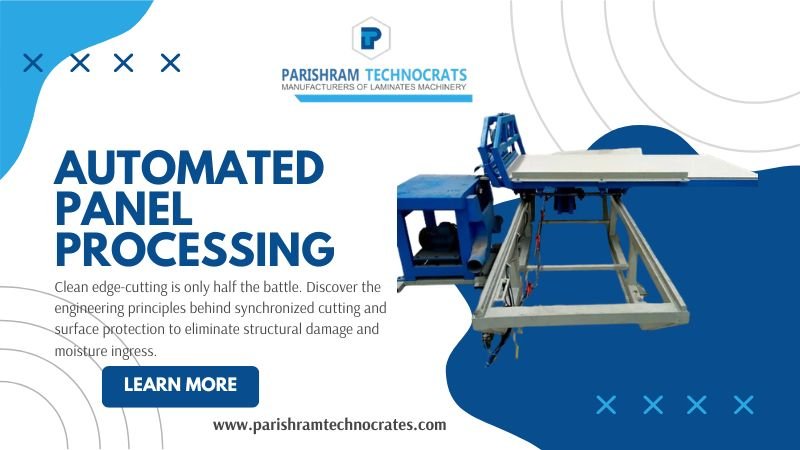
An integrated production line that combines a heavy duty cutting machine with an automatic PP wrapping machine eliminates these risks by delivering precise panel sizing, consistent edge quality, and reliable surface protection.
At Parishram Technocrats, we design end-of-line automation systems that help manufacturers improve productivity, reduce scrap, and protect finished panels throughout storage and transportation.
1. Precision Cutting: The Foundation of Quality Panel Processing
The quality of a finished panel begins with the accuracy of the cutting process.
Whether processing decorative laminates, HPL sheets, MDF boards, or multi-layer plywood, every cut must remain perfectly straight while preventing surface chipping and structural stress.
Industrial cutting machines achieve this through advanced engineering rather than simply using larger motors.
Linear Guide Rail Accuracy
One of the most important features of a modern heavy duty cutting machine is its hardened linear guide rail system.
Unlike conventional guide mechanisms, precision linear rails:
- Eliminate lateral movement
- Reduce vibration during cutting
- Maintain blade alignment
- Produce perfectly square edges
- Improve dimensional consistency
Higher linear guide rail accuracy means every panel matches design specifications, reducing rework during edge banding or furniture assembly.
Carbide-Tipped Saw Blades
Another critical factor is blade technology.
Premium cutting systems use carbide-tipped saw blades, offering:
- Longer operating life
- Better heat resistance
- Lower blade deflection
- Cleaner cutting edges
- Reduced maintenance frequency
Because carbide remains sharper for significantly longer than standard steel blades, manufacturers achieve consistent cutting quality even during continuous production shifts.
Scoring Blade Synchronization
Decorative laminates often chip when the main blade exits the material.
To eliminate this problem, industrial machines use synchronized scoring blades.
The scoring blade creates a shallow groove beneath the sheet moments before the primary blade passes through the panel.
This process:
- Prevents decorative layer splintering
- Produces smooth edges
- Reduces material rejection
- Improves finishing quality
For manufacturers producing premium furniture panels, this feature is essential rather than optional.
2. Surface Protection Through Automatic PP Wrapping
Perfectly cut panels still remain vulnerable after processing.
Dust, humidity, friction, and handling during transportation can quickly damage finished surfaces.
An automatic PP wrapping machine provides immediate protection before the panels leave the production line.
Uniform Surface Tension Adhesion
Manual wrapping creates inconsistent pressure.
This commonly causes:
- Air bubbles
- Loose film
- Wrinkles
- Partial edge coverage
Automatic systems use calibrated pressure rollers to ensure controlled surface tension adhesion across the complete sheet.
The result is:
- Bubble-free wrapping
- Uniform film tension
- Smooth appearance
- Strong edge sealing
- Easy film removal without adhesive residue
Moisture and Dust Protection
Wood-based products naturally absorb moisture.
Even slight humidity exposure during warehouse storage or transportation may lead to:
- Swelling
- Warping
- Surface deformation
- Decorative laminate separation
Complete PP wrapping creates an effective barrier against:
- Moisture ingress
- Dust contamination
- Handling scratches
- Abrasion during transport
This level of substrate protection significantly reduces customer complaints and product returns.
3. Creating a Continuous Production Workflow
Modern manufacturing efficiency depends on eliminating interruptions between production stages.
Instead of moving panels manually between different workstations, manufacturers increasingly adopt integrated industrial packaging workflows.
A typical automated line includes:
Material Positioning
Surface Calibration
High-Speed Cutting
The heavy duty cutting machine performs accurate sizing using precision guide systems and carbide blades.
Automated Material Transfer
Automatic Wrapping
The automatic PP wrapping machine applies protective film immediately before stacking and dispatch.
This synchronized workflow offers several operational advantages:
- Faster production cycles
- Reduced labor dependency
- Lower material handling damage
- Improved operator safety
- Better production planning
- Consistent finished product quality
4. Panel Sizing Optimization and Material Yield
Automation is not only about increasing production speed.
It also improves material utilization.
Effective panel sizing optimization allows manufacturers to maximize every sheet by minimizing unused material between components.
Modern cutting systems use optimization software that calculates the most efficient cutting layout based on required panel dimensions.
Benefits include:
- Reduced material waste
- Lower production cost
- Better inventory utilization
- Higher output from every sheet
Even reducing waste by a few percentage points can generate significant annual savings for high-volume production facilities.
Managing Sawdust with Efficient Dust Collection
Precision cutting produces fine wood dust that affects both machinery performance and product quality.
Accumulated dust can:
- Reduce blade visibility
- Increase cutting temperatures
- Affect measurement accuracy
- Shorten machine life
Integrating a Pulse Jet Dust Collector continuously removes airborne particles directly from the cutting zone.
Benefits include:
- Cleaner work environment
- Improved blade cooling
- Better cutting accuracy
- Longer equipment life
- Reduced maintenance downtime
Dust extraction also helps manufacturers comply with workplace safety and environmental standards while maintaining uninterrupted production.
5. Why Integrated Automation Delivers Higher ROI
Many manufacturers initially evaluate machines based solely on purchase price.
However, the true return comes from combining multiple automated processes into one seamless production line.
Integrated systems reduce:
- Manual labor requirements
- Material handling damage
- Packaging inconsistencies
- Production bottlenecks
- Machine idle time
- Product rejection rates
The result is higher throughput, lower operating costs, and improved customer satisfaction.
Instead of treating cutting, wrapping, conveying, and dust collection as separate investments, forward-looking manufacturers view them as a single productivity ecosystem.
That is where the greatest long-term value is created.
Conclusion: Complete Every Panel with Precision
The final stages of manufacturing have the greatest influence on customer satisfaction.
A perfectly sanded panel loses its value if chipped during cutting or damaged during transportation.
By combining a precision heavy duty cutting machine, automated conveying, dust collection, and an automatic PP wrapping machine, manufacturers achieve consistent quality while reducing operational costs and product losses.
At Parishram Technocrats, we engineer complete end-of-line automation solutions designed for continuous industrial production. From precision cutting systems to integrated wrapping and packaging lines, our equipment helps manufacturers improve efficiency, protect finished products, and maximize long-term profitability.
Ready to modernize your panel processing line?
Explore our Automated Wrapping & Cutting Solutions or contact our engineering team in Ahmedabad for a customized production layout tailored to your manufacturing requirements.