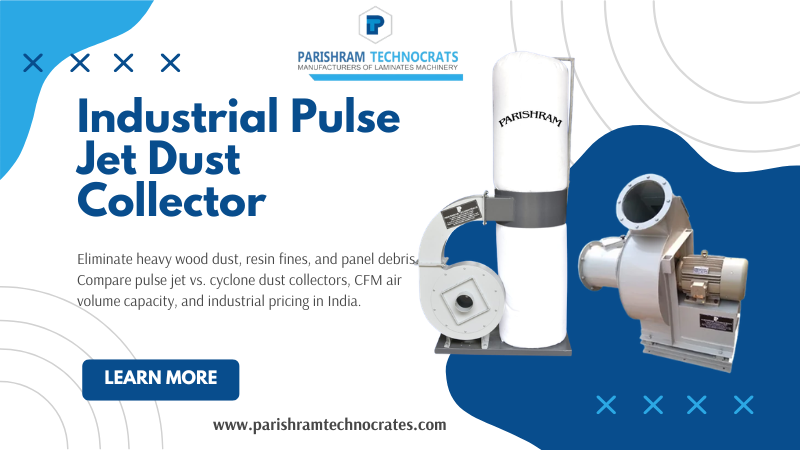
In high-output panel processing mills, plywood plants, laminate manufacturing units, and chemical processing facilities, air filtration is as critical as your primary machinery. Continuous cutting, panel sizing, and high-speed sanding produce massive volumes of fine airborne particulate.
Without an adequate extraction setup, fine dust settles inside machinery components—causing linear guide failure, electrical panel short circuits, and poor surface finishing.
Installing a heavy-duty pulse jet baghouse dust collector ensures continuous online air filtration, keeping your plant compliant with environmental standards while protecting your primary equipment.
Request Factory Layout & Dust Collector Quotation
1. Pulse Jet Baghouse vs. Cyclone Separators: Which System Fits Your Line?
Choosing the correct filtration system depends on the particle size, dust volume, and whether continuous 24/7 operational capability is required.
Option A: Pulse Jet Baghouse System
- Primary Function: Continuous online filtration using high-pressure compressed air pulses to dislodge fine dust cake while the system remains fully operational.
- Particle Separation: Captures micro-fines down to 1 to 5 microns with up to 99.9% efficiency.
- Ideal For: Wide belt sanding lines, chemical processing, powder coating, and high-precision panel manufacturing.
Option B: Heavy-Duty Cyclone Separator
- Primary Function: Centrifugal separation that forces heavy, coarse particulate to drop into a hopper.
- Particle Separation: Handles large debris (>50 microns) such as thick wood chips, edge-banding trimmings, and heavy shavings.
- Ideal For: Primary pre-filtration before a main baghouse, coarse sawlines, and heavy planing operations.
Engineering Comparison Overview
| Specification / Feature | Pulse Jet Baghouse System | Single/Multi-Cyclone Separator |
|---|---|---|
| Filtration Mechanism | Reverse compressed air pulse through needle-felt bags | Centrifugal force & gravitational settlement |
| Collection Efficiency | 99.5%+ (Captures PM2.5 & fine sanding dust) | 85% to 92% (Coarse particles & heavy chips) |
| Air Volume Capacity | 2,000 to 50,000+ CFM (Modular scaling) | 1,500 to 15,000 CFM |
| Cleaning Method | Automatic sequential pulse-jet controller | Gravity discharge to hopper or airlock valve |
| Best Application | Micro-fine resin dust, panel sanding, continuous production | High-volume wood chips, sawmills, coarse pre-separation |
2. Working Principle: How Online Reverse Pulse Jet Cleaning Works
A pulse jet dust collector removes airborne contaminants continuously through a 4-stage process:
- Dust Capture & Intake: High-velocity suction draws dust-laden air from extraction hoods into the lower hopper plenum.
- Surface Filtration: Air flows from outside to inside through high-density non-woven polyester filter bags supported by heavy-wire cages. Fine particulate forms a primary “dust cake” on the outer bag surface.
- Automated Reverse Pulse: A digital timer/differential pressure PLC triggers high-pressure solenoid valves. A short shockwave of compressed air (5 to 7 bar) fires down through a venturi nozzle, flexing the filter bags outward and shedding the dust cake into the collection hopper below.
- Clean Air Discharge: Filtered air exits through the clean air chamber and centrifugal fan outlet, exceeding statutory environmental air standards.
3. Key Factors That Determine Industrial Dust Collector Pricing
Commercial quotes for complete extraction systems in India vary based on operational scope and design parameters:
- Airflow Sizing (CFM / m3 / hr): System pricing scales directly with the total air volume needed to serve all suction hoods across your factory floor simultaneously.
- Filter Media Selection: Non-woven polyester is standard for dry wood dust. Anti-static, PTFE-coated, or Nomex media are used for volatile or high-temperature applications.
- Exhaust Fan Motor Power: High-efficiency backward-curved centrifugal blowers (7.5 HP to 50+ HP) deliver static pressure needed for extensive duct networks.
- Discharge Mechanism: Manual butterfly valves offer lower upfront costs, while motor-driven Rotary Airlock Valves allow continuous discharge into waste compactors without losing suction pressure.
Why Choose Parishram Technocrats Air Pollution Control Systems?
At Parishram Technocrats, our industrial air handling systems are tailored to keep high-output factories clean and compliant:
- Precision Air-to-Cloth Ratio: Custom-calculated ducting network ensures maximum static pressure at every machine hood.
- Heavy-Gauge MS/SS Fabrication: Built with reinforced mild steel or stainless steel housings to handle negative pressure without panel deflection.
- Turnkey Equipment Integration: Tailored to integrate seamlessly with Wide Belt Laminate Sanding Machines, Automatic PP Board Wrapping Lines, and industrial panel sizing saws.