
1. The Real Cost of Manual Material Handling
At first glance, manual labor seems economical. But when you calculate operational reality, the cost structure expands significantly beyond wages.
 Inconsistent Production Flow
Human fatigue is inevitable. Over an 8–12 hour shift, output speed decreases, leading to uneven production cycles and bottlenecks at critical machines.
Product Damage & Quality Loss
Manual shifting of heavy or delicate materials—such as laminates, steel sheets, or processed components—often leads to:
- Edge chipping
- Surface scratches
- Misalignment damage
Even a small defect rate can significantly impact monthly profitability.
Safety & Compliance Risks
Repeated lifting operations increase the chances of:
- Musculoskeletal injuries
- Accident-related downtime
- Insurance and compensation liabilities
These hidden losses often exceed the visible labor savings.
2. The Efficiency Advantage of Automated Conveyor Systems
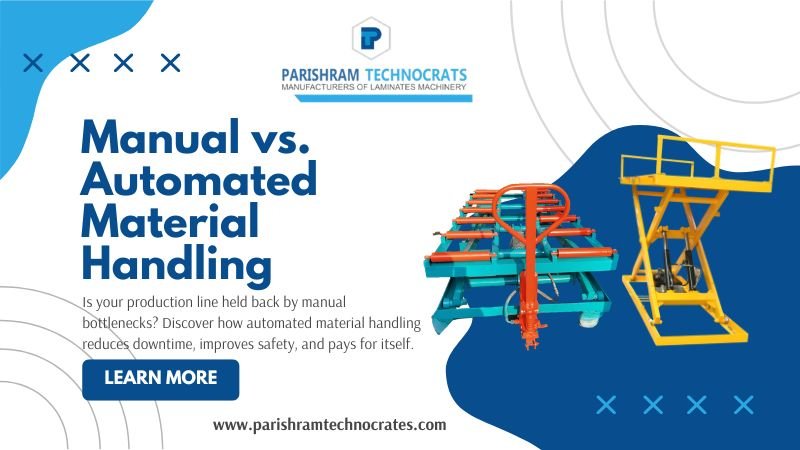
Modern industrial conveyor systems replace irregular human movement with consistent, engineered flow.
 Continuous Production Flow
Unlike manual transfer, conveyors ensure uninterrupted feeding of machines such as cutters, sanders, and packaging units. This keeps equipment running at optimal capacity without idle time.
 Space Optimization
Advanced conveyor layouts—straight, inclined, or overhead—maximize factory space utilization. This allows better line balancing and reduces congestion on the shop floor.
 Energy & System Efficiency
High-quality conveyor systems use branded motors and precision gearboxes, improving torque efficiency and reducing long-term electricity consumption.
In terms of industrial conveyor benefits, the biggest advantage is not speed—it is stability and predictability of output.
3. Solving Vertical Bottlenecks with Hydraulic Scissor Lifts
One of the most overlooked inefficiencies in factories is vertical material movement.
Manual lifting to mezzanine floors, storage racks, or high-entry machines slows production and creates safety risks.
A Hydraulic Scissor Lift transforms this bottleneck into a controlled, ergonomic process.
 Why it improves ROI:
- Reduces manpower requirement per cycle
- Maintains consistent working height
- Improves loading/unloading speed
- Minimizes worker fatigue and injuries
In many factories, especially in factory efficiency India-driven operations, a well-planned scissor lift installation can recover its investment within months through labor optimization alone.
4. Integration: Where Real Industrial ROI Is Created
True efficiency does not come from standalone machines—it comes from system integration.
For example:
- A conveyor feeding a cutting machine
- A scissor lift supporting vertical transfer
- A Pulse Jet Dust Collector synchronised with sanding or grinding operations
This creates a fully controlled ecosystem where each process supports the next.
Integrated systems also reduce hidden costs like:
- Motor wear due to dust accumulation
- Manual cleaning downtime
- Unplanned maintenance cycles
At Parishram Technocrats, we design systems that work as a connected production line—not isolated machines.
5. How to Calculate ROI for Automation
A simple but powerful way to evaluate automation is:
(Manual Labor Cost + Product Damage Loss + Downtime Cost)
(Machine EMI + Maintenance Cost)
If the left side is higher, automation is already financially justified.
 Example:
- Manual handling = ₹1.2 lakh/month (labor + losses)
- Automation EMI + maintenance = ₹80,000/month
 Immediate net saving: ₹40,000/month + improved output consistency
This is why hydraulic scissor lift ROI and conveyor automation often outperform traditional manual systems within 6–18 months.