
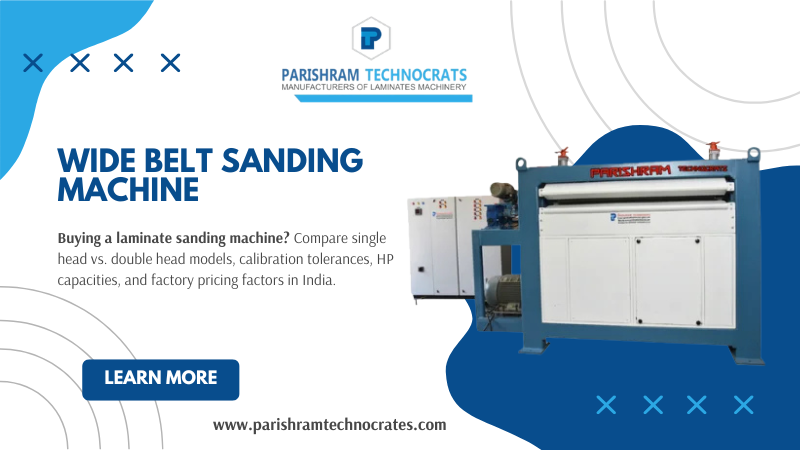
For decorative laminate manufacturers, plywood producers, and high-pressure panel processing plants, surface finishing and precise thickness calibration determine product quality. Variations in sheet thickness or minor swirl marks lead to board rejections, poor bonding during pressing, and wasted raw materials.
Investing in a heavy-duty wide belt sanding machine resolves panel variation issues. However, choosing between single-head vs. double-head configurations, rubber vs. steel contact rollers, and various motor capacities requires careful consideration.
This guide breaks down the technical selection criteria, belt sizing, calibration tolerances, and commercial pricing factors to help you select the ideal panel sanding system for your production line.
Need Machine Specifications or a Factory Quote?
1. Single Head vs. Double Head Sanding Machines: Which Do You Need?
Choosing the right configuration depends on your daily sheet volume and whether you require heavy stock calibration, fine surface finishing, or both.
Single Head Automatic Model
- Primary Function: Single-pass calibration or surface finishing.
- Best Suited For: Mid-sized workshops, custom order batches, and standard panel processing.
- Operational Benefit: Compact footprint, lower power consumption, and fast setup for varying board thicknesses.
Double Head Heavy-Duty Model
- Primary Function: Dual-action processing—heavy stock removal and fine polishing in a single pass.
- Best Suited For: High-output plywood mills, HPL manufacturing plants, and continuous production lines.
- Operational Benefit: Doubles throughput by eliminating the need to run boards through a second machine pass.
| Specification / Feature | Single Head Automatic Model | Double Head Heavy-Duty Model |
| Primary Function | Single-stage thickness sizing or final finishing | Simultaneous heavy calibration & ultra-fine surface finishing |
| Calibration Tolerance | ±0.02 mm | Up to pm ±0.01 mm Micro-Level Precision) |
| Belt Dimensions | Standard sizes (e.g., 1920 x 1320 mm ) | Heavy-duty sizes (e.g., 2620 x 1320 mm) |
| Main Roller Type | Hard Chrome Plated Steel Roll or Rubber Roll | Roll 1: Hard Chrome Steel Roll (Grooved) Roll 2: Cushion Rubber/Combo Roller |
| Best Suited For | Small-to-mid wood workshops & laminate processing units | High-output plywood mills, HPL, & decorative sheet manufacturing plants |
2. Key Technical Features That Drive Output Quality
When evaluating sanding machines from an industrial manufacturer, these core engineering components dictate longevity and surface consistency:
- Heavy-Duty Steel Body Frame: Panel calibration involves substantial contact pressure. Lightweight frames cause vibration chatter marks on thin laminate sheets. A solid box-pipe structure dampens vibration for a smooth finish.
- Grooved Hard-Chrome Steel Rollers (Dia. 320 mm): Heavy steel contact rolls ensure rigid calibration without flexing, eliminating thick-and-thin edge defects across 4-foot or 8-foot sheets.
- Pneumatic Disc Braking Systems: Emergency pneumatic disk brakes stop high-speed sanding belts instantly during belt breakage, protecting internal rollers and machine components.
- Digital PLC & AC Variable Feed Drives: Precise digital thickness adjustments let operators shift between 0.5 mm thin laminates and heavy 25 mm boards seamlessly.
3. What Drives Industrial Sanding Machine Prices in India?
Commercial quotes for wide belt sanders vary based on four primary manufacturing options:
- Motor Horsepower (HP): Higher HP main drive motors allow deeper material removal per pass without overheating or stalling during continuous shifts.
- Automation & Tracking Controls: Pneumatic oscillation and electronic sensor-based belt tracking prevent sanding paper drift and premature belt wear.
- Integrated Extraction Points: Heavy sanding creates fine dust. Units equipped with triple-dust suction ports integrate directly with [Industrial Pulse Jet Dust Collectors] to maintain clean shop floors and extend belt life.
Why Choose Parishram Technocrats Panel Processing Equipment?
At Parishram Technocrats, our wide belt laminate sanding machines are engineered for demanding 24/7 industrial production environments:
- Rigid Calibration: Consistently maintains ±0.01 mm thickness tolerances across every sheet.
- High Output Rates: Built to handle continuous panel feeding schedules without thermal stoppage.
- Complete Line Integration: Pairs with our Laminate Sheet Cutting Machines, Automatic PP Board Wrapping Machines, and Hydraulic Scissor Lifts for complete panel handling systems.





 Users Today : 14
 Users Last 30 days : 148
 Users This Month : 148