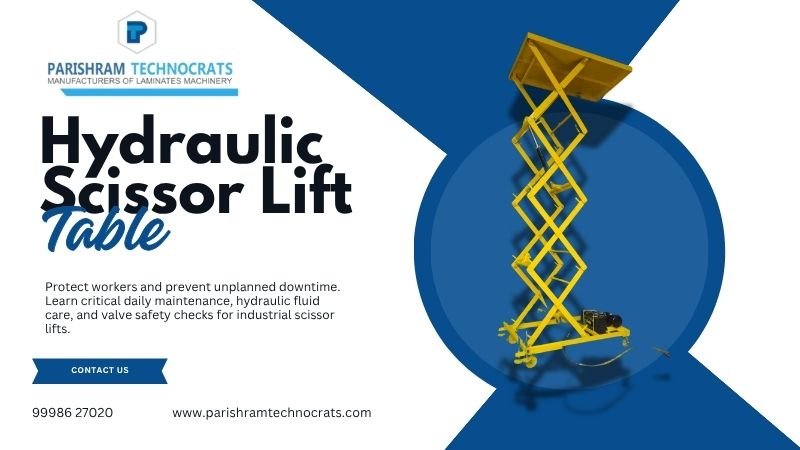
In heavy manufacturing plants, automated assembly lines, and warehousing facilities, hydraulic scissor lift tables are critical for continuous vertical material handling. However, because these machines routinely handle loads from 1 ton to over 20 tons under harsh shift conditions, routine maintenance is essential.
Neglecting hydraulic oil changes, ignoring pin wear, or bypassing safety valves can lead to platform tilting, hydraulic fluid overheating, slow lifting speeds, and sudden mechanical failures.
Following a structured preventative maintenance schedule protects your workforce, prevents expensive emergency repairs, and ensures your lifting equipment operates reliably for years.
Need Factory Inspection Support or Spare Parts?
1. Essential Preventative Maintenance Schedule
A. Daily Pre-Shift Operator Inspections
- Visual Leak Checks: Inspect hydraulic hose connections, cylinder seals, and power pack fittings for fluid weepage or pooling.
- Platform Travel Test: Run the lift through one full elevation and lowering cycle without a load to verify smooth motion, quiet pump operation, and zero jerky movement.
- Emergency Stop & Safety Bar Verification: Confirm that perimeter safety trip bars and emergency stop buttons immediately halt downward travel when engaged.
B. Weekly & Monthly Engineering Maintenance
- Scissor Arm Pivot Lubrication: Grease all scissor arm center pivot pins, cylinder trunnion mounts, and base roller tracks using high-pressure lithium grease.
- Hydraulic Oil Reservoir Level & Clarity: Check oil level in the power pack tank. Dark, milky, or burnt-smelling oil indicates thermal breakdown or moisture contamination and requires immediate flushing.
- Structural Weld & Bolt Inspection: Check all floor mounting anchor bolts, cylinder mounting clevises, and structural scissor welds for signs of stress cracks or looseness.
Maintenance Task Overview
| Frequency | Target Area | Inspection Action | Primary Objective |
| Daily | Safety Bars & E-Stops | Functional mechanical trip test | Operator protection & accident prevention |
| Weekly | Scissor Bushings & Pins | High-pressure grease application | Prevent pin binding & uneven arm wear |
| Monthly | Hydraulic Power Pack | Filter element check & breather cleaning | Prevent pump cavitation & valve clogging |
| Bi-Annually | Hydraulic Oil & Seals | Oil degradation test & cylinder seal check | Prevent height drift & pressure drops |
2. Identifying & Fixing Common Hydraulic Lift Operational Issues
When performance degrades on the factory floor, identifying the root cause quickly gets your line back up and running.
-
Problem: Platform Height Drift (Slow Downward Creep)
-
Root Cause: Debris seated in the pilot-operated check valve or worn internal piston seals in the hydraulic cylinder.
-
Solution: Clean or replace the check valve cartridge and flush the hydraulic circuit to remove micro-particulates.
-
-
Problem: Jerky or Stuttering Vertical Travel
-
Root Cause: Air trapped inside the hydraulic lines or lack of lubrication on base frame rollers.
-
Solution: Bleed air from the cylinder top ports and apply heavy-duty lubricant along the base guide tracks.
-
-
Problem: Slow Lifting Speed Under Rated Load
-
Root Cause: Low hydraulic fluid level, degraded pump gears, or misadjusted main relief valve pressure.
-
Solution: Top up oil level, check system working pressure with a diagnostic gauge, and verify motor voltage.
-
3. Critical Safety Features Essential for Factory Compliance
To ensure complete worker safety and meet industrial safety standards, every heavy-duty scissor lift table should feature four integrated safety mechanisms:
- Hose-Burst Velocity Fuses: Mounted directly inside the cylinder port, these valves instantly trap oil inside the cylinder if a supply hose bursts, preventing a free fall.
- Maintenance Safety Props / Bars: Heavy mechanical steel bars that swing into place to lock the arm mechanism during maintenance work under the deck.
- Perimeter Safety Trip Frames: Touch-sensitive aluminum or mechanical frames under the top platform edge that immediately halt lowering if an obstacle is touched.
- Overload Relief Valves: Factory-set pressure relief valves that bypass fluid back to the reservoir if an operator attempts to lift beyond rated tonnage capacity.
Why Choose Parishram Technocrats Material Handling Machinery?
At Parishram Technocrats, we build industrial scissor lifts with heavy structural steel mass and over-engineered safety factors:
- Heavy-Duty Structural Mass: Built with solid steel arm links to withstand aggressive shock-loading from forklifts and heavy pallets.
- Zero-Drift Hydraulics: Integrated with high-grade valve manifolds and hardened seals for long-term position holding.
- Complete System Integration: Pairs smoothly with our Industrial Conveyor Systems, Wide Belt Sanding Machines, and Automatic PP Board Wrapping Lines.




 Users Today : 8
 Users Last 30 days : 107
 Users This Month : 107