
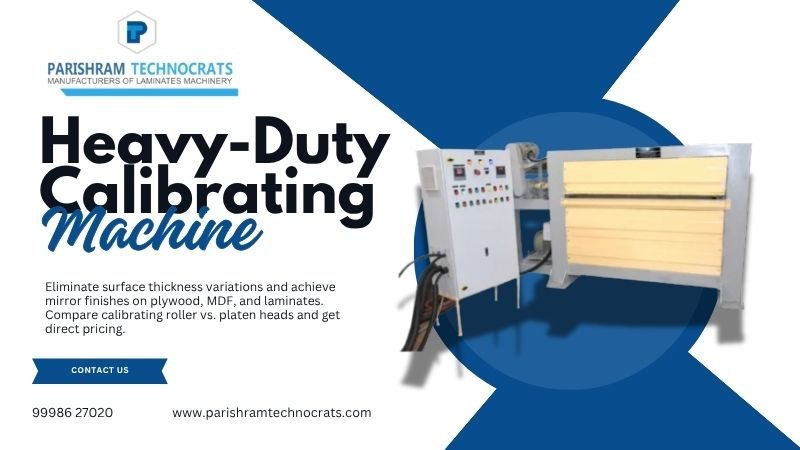
In high-volume plywood manufacturing, flush door production, blockboard calibration, and modular furniture fabrication, surface calibration and smoothness dictate product grade. Plywood sheets with uneven thickness across the 8×4 ft surface cause gaps, delamination, and bonding failures during subsequent hot-pressing and laminating stages.
Manual sanding or basic single-drum sanders cannot maintain tight calibration tolerances, resulting in excessive material waste and high labor costs.
Installing a heavy-duty industrial wide belt sanding and calibrating machine automates precision thickness calibration and delivers a fine, uniform surface finish across wood, MDF, particle boards, and decorative veneers.
Upgrade Your Panel Finishing Precision Today
1. Calibrating Roller Heads vs. Combination Platen Heads: Choosing the Right Setup
Option A: Heavy-Duty Calibrating Roller Heads (Steel or Grooved Rubber)
- Operation: Rigid steel or heavy grooved rubber contact rollers that apply high pressure directly to high spots across the board.
- Operational Advantage: Delivers aggressive stock removal and precise thickness calibration, leveling out natural thickness variances in raw plywood and blockboards.
- Best Suitable For: Primary core stock calibration, calibration of high-density fiberboards, and heavy material removal before veneering.
Option B: Combination Platen & Roller Finishing Heads
- Operation: Features a contact roller followed immediately by an adjustable electronic or pneumatic sanding platen on a single head unit.
- Operational Advantage: The roller removes high spots while the flat platen smooths out sanding scratches, delivering a scratch-free, mirror-like surface finish.
- Best Suitable For: Final face sanding on pre-laminated boards, high-gloss veneer finishing, and smooth surface preparation prior to painting or PU coating.
Technical Comparison Overview
| Specification / Feature | Calibrating Roller Head | Combination Platen Head |
| Primary Function | Aggressive thickness calibration & stock removal | Fine surface smoothing & scratch elimination |
| Contact Mechanism | Grooved rubber or precision steel roller | Combined roller + adjustable graphite platen pad |
| Material Removal Rate | High stock removal (up to 1.5 to 2 mm per pass) | Fine finishing (minimal stock removal) |
| Surface Finish Quality | Clean calibrated surface with minor feed marks | Ultra-smooth surface ready for coating or lamination |
| Ideal Application | Raw plywood calibrating, core board sizing | Face veneer sanding, MDF finishing, final prep |
2. Core Engineering Features Built into Parishram Sanding Machines
Our wide belt sanding and calibrating machines are engineered with heavy cast frames and advanced pneumatic controls to withstand continuous industrial duty cycles:
- Pneumatic Oscillating Belt Tracking: Infrared optical sensors and high-speed pneumatic cylinders keep sanding belts centered on contact drums, preventing edge tearing and belt wear.
- Heavy Cast-Iron Bed and Frame: Rigid, vibration-free machine bodies absorb high-frequency harmonics, ensuring flawless thickness uniformity across wide panel passes.
- Emergency Disc Brakes: Pneumatically actuated emergency braking systems halt heavy sanding drums within seconds if a belt slips or power is interrupted.
- Digital Thickness Readouts & Feed Control: Variable frequency drive (VFD) feed belt controls paired with digital thickness displays allow precise control down to 0.05 mm tolerances.
- Vacuum Hold-Down Table Systems: Built-in high-volume vacuum suction blowers lock thin, warped, or flexible panels firmly against the conveyor bed during high-speed feeding.
3. What Drives Wide Belt Sanding Machine Prices in India?
Commercial quotes for industrial sanding and calibrating machinery depend on several core engineering choices:
- Number of Working Heads: Single-head, double-head (Roller + Platen), and triple-head (Roller + Roller + Platen) configurations scale directly with production throughput and finishing requirements.
- Working Width Capacity: Standard widths (such as 1,300 mm for 4-foot sheets) versus extra-wide models (1,600 mm or 2,000 mm) dictate heavy frame sizing and motor power requirements.
- Main Motor Horsepower Ratings: Upgrading from standard 15 HP motors to heavy-duty 20 HP, 30 HP, or multi-motor setups allows continuous high-torque material removal.
- Brush Unit & Cleaning Additives: Integrating web-cleaning rotary nylon or horsehair cleaning brushes at the outfeed removes residual fine dust particles before packaging.
Why Choose Parishram Technocrats Panel Finishing Equipment?
At Parishram Technocrats, we build high-performance industrial machinery engineered to integrate smoothly into complete automated lines:
- Rigid Industrial Construction: Built to handle heavy multi-shift operations without structural thermal expansion or calibration drift.
- Seamless Line Workflow: Engineered to interface directly with our Panel Sizing Machines, Industrial Conveyor Systems, and Hydraulic Scissor Lift Tables.
- Reliable Pan-India Support: Complete installation, calibration training, and readily available spare sanding belts and parts directly from our manufacturing hub in Ahmedabad.





 Users Today : 8
 Users Last 30 days : 39
 Users This Month : 39